

Explore the interactive MiWear survey dashboard: HERE
What makes a health wearable useful enough to become part of everyday life?
The MiWear survey points to a clear answer: people want reliable devices that fit comfortably, protect their information and explain their health data in a way they can trust.
What People Want from Everyday Health Wearables: Insights from the MiWear Survey
The most advanced health wearable is of little value if it spends too much time charging, feels uncomfortable or leaves people unsure about what happens to their information. This simple idea is one of the clearest messages to emerge from the MiWear wearable wellbeing survey.
Drawing on more than 1,200 responses, the survey explored how people use wearables today and what they would expect from a new device. The findings reveal genuine interest in wearable wellbeing technology, but they also show that adding more sensors is only part of the story. For a wearable to become part of everyday life, it must be practical, understandable and trustworthy.
The new interactive MiWear dashboard brings these findings together and allows visitors to explore what people said about product features, trust, comfort, inclusive design and their interest in future wearable technology.
Reliability comes before novelty
When people were asked what they wanted from a wearable, everyday practical features came first. Long battery life, water resistance and compatibility with different smartphones were among the most common priorities.
This does not mean that people are uninterested in new health measurements. Features such as useful alerts and glucose information also attracted attention. However, advanced functions are unlikely to compensate for a device that is difficult to maintain or does not fit naturally into a person’s routine.
For developers, the message is straightforward: innovation must be built on a dependable foundation. A wearable should be available when people need it, work with the technology they already use and require as little effort as possible to keep running.
Trust must be designed into the experience
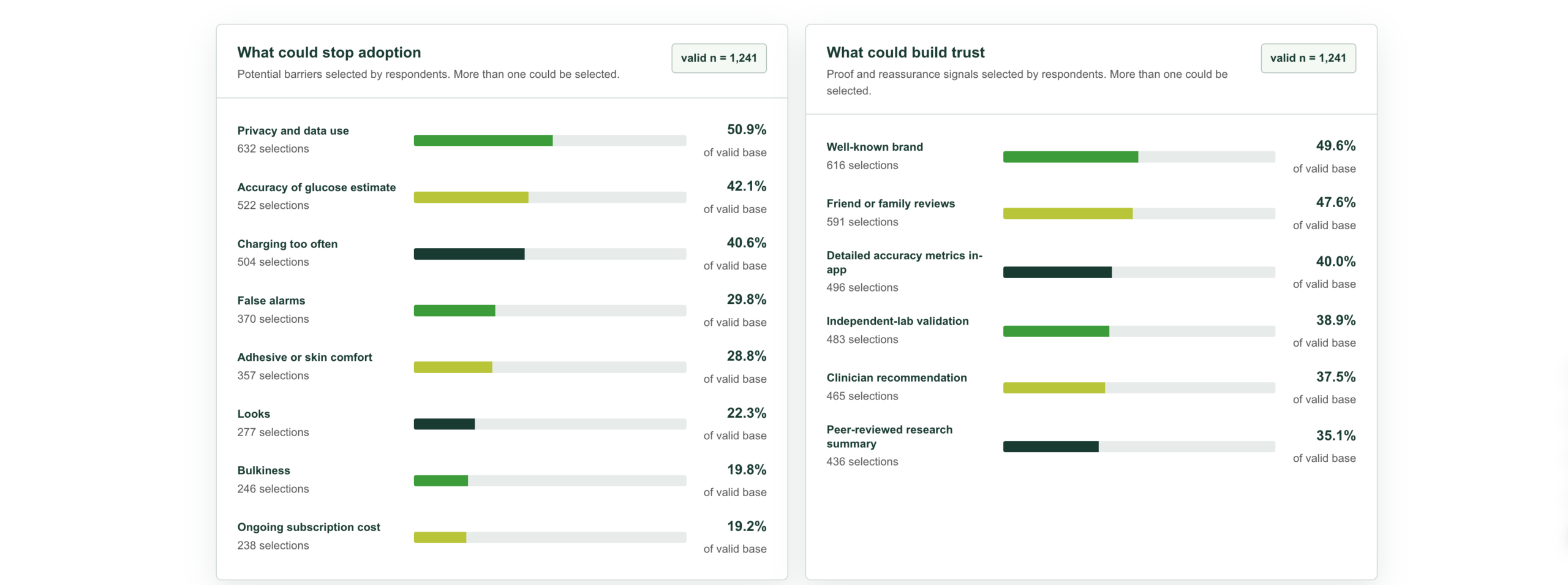
People also expressed concerns about privacy, the accuracy of health information and the need to charge devices too often. Similar frustrations appeared when they described their experiences with existing tools, including doubts about accuracy, too many disconnected apps, discomfort and cost.
These concerns show that trust is not created by a single badge or statement. It develops through the whole experience of using a product.
A familiar brand or a recommendation from friends and family can provide reassurance. At the same time, people also want more concrete forms of evidence: clear information about accuracy, independent testing, recommendations from health professionals and accessible summaries of research.
Wearable companies therefore need to explain what a device can measure, how reliable that information is and how personal data will be used. Privacy settings, performance information and explanations of uncertainty should be easy to find and understand. They should not be hidden in lengthy technical documents.
A wearable must fit into everyday life
Smartwatches were the most familiar and widely preferred format in the survey, although wrist bands and rings also appealed to many participants. Each format offers different possibilities, but the choice is about more than appearance.
A device may be worn while working, exercising, sleeping or socialising. Its size, weight, charging routine and contact with the skin all influence whether it feels helpful or intrusive. A format that looks attractive in a product image may feel very different after several days of continuous use.
The information people already track also offers useful clues. Steps, heart rate and sleep were among the most familiar wellbeing measures. These familiar ideas can help people understand new types of health information, provided that the device presents them clearly and avoids overwhelming the user.
The challenge is not simply to collect more data. It is to turn that data into information people can understand and use.
Inclusive design begins with real people
Wearables sit directly on the body, which means that fit, placement and skin response cannot be treated as minor details. Survey participants highlighted possible differences in measurement accuracy, skin sensitivity, sizing and where a device is worn. They also pointed to the potential importance of hormonal changes and other differences between bodies.
These concerns do not prove that any particular device performs differently for different groups. Instead, they show where careful research and testing are needed.
Designing for an imagined “average user” can leave many people with a product that fits poorly or does not work well in their circumstances. Inclusive development means involving people with different bodies, needs and daily routines from the beginning. It also means testing comfort and performance in real situations, not only under ideal conditions.
Interest is only the beginning
Many survey participants responded positively to the proposed wearable concept and said they would be interested in trying it. This is an encouraging sign for the MiWear project, but interest alone does not guarantee that a device will be purchased or used over time.
The next step is to understand what happens when people interact with a real product. Do they find it comfortable? Can they understand the information it provides? Do they trust it enough to keep using it? Does it continue to offer value once the novelty has worn off?
Prototype studies and longer-term user testing can help answer these questions. They can also show how people balance competing priorities such as advanced features, privacy, comfort, evidence and cost.
Explore the MiWear survey dashboard
The MiWear survey suggests that the future of wearable wellbeing technology will not be shaped by sensors alone. People want devices that work reliably, fit naturally into daily life and give them confidence in both the information they receive and the way their personal data are handled.
The interactive dashboard offers a closer look at these findings. Visitors can explore the different topics, compare people’s priorities and learn how the results can support future product research and design.
Explore the interactive MiWear survey dashboard: HERE
About the survey
The dashboard combines the survey responses while protecting participants’ identities. The findings describe the people who took part and should not be interpreted as market share, medical advice or proof of how a particular device will perform. They are intended to guide further research, product development and user testing.
Reference
MiWear wearable wellbeing survey. Interactive survey dashboard. Analysis date: 27 July 2026.
Acknowledgements
This work was carried out by the FRESCI by SCIENCE&STRATEGY SL team: Dr. M. Straccia; Ms. F. Solano; Ms. M. Ruiz; Dr. Avogaro; Dr. L. Maggioni; Dr. I. Campia; Dr. N. Escacena; Dr. F. Rossi; and Ms. A. Serramitjana.
- Marco Straccia from FRESCI
- No Comments